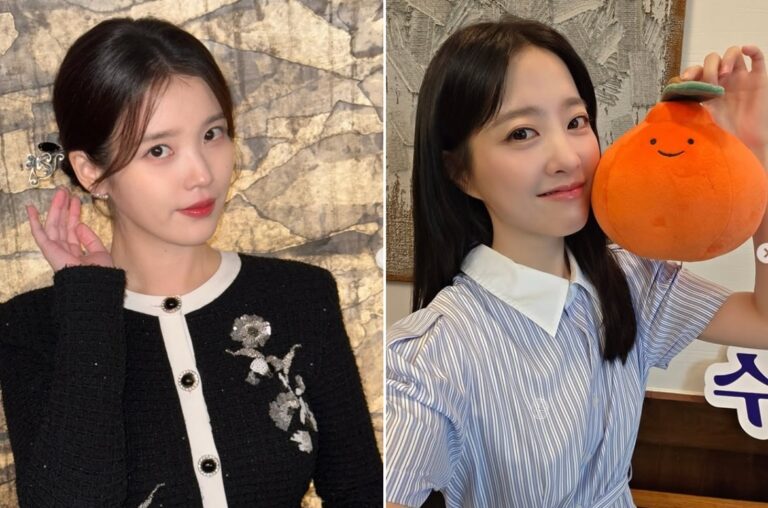
Singer and actress IU and actress Park Bo-young. (Photos / IU and Bo-young SNS)
Celebrities have every right to express political opinions, but should they? As political polarization deepens, public entertainers face growing pressure to choose sides—often at the cost of their role as cultural unifiers.
As political polarization deepens, South Korea’s entertainment industry has increasingly found itself caught in the crossfire. Recent debates surrounding election-related controversies have expanded beyond politics, prompting renewed scrutiny of celebrities’ political expressions and social activism.
No one disputes that celebrities, like all citizens, possess the right to hold and express political opinions. Democracy guarantees freedom of speech regardless of profession.
The question, however, is not whether entertainers have political rights. It is whether public figures whose careers depend on support from a broad and diverse audience should exercise greater caution when engaging in highly divisive political issues.
Recent reactions toward singer and actress IU illustrate this dilemma.
In 2024, IU received widespread praise from many progressive supporters after reportedly providing prepaid food and beverages for young people attending rallies opposing martial law measures. At the time, her actions were viewed by supporters as a meaningful gesture of solidarity.
Today, however, some citizens who are protesting what they describe as election-related fairness and voting-rights concerns are asking why similar support has not been extended to their cause. Critics argue that celebrities who choose to publicly support one political movement while remaining silent on another create an appearance of selective activism.
Whether this criticism is fair or not is ultimately beside the point.
The controversy highlights a broader challenge facing public entertainers. Once people associate a celebrity with a particular political cause, they interpret every future action—or inaction—through a political lens. Audiences may judge what someone intended as a humanitarian gesture later as a partisan statement. Maintaining neutrality becomes increasingly difficult for entertainers.
Similar dynamics have emerged in discussions involving actress Park Bo-young and singer JK Kim Dong-wook. In an era dominated by social media, public figures often enter political controversies regardless of their original intentions. Observers scrutinize their statements, appearances, and online activity not as personal expressions but as political signals.
Neither politics nor entertainment is benefited by this trend.
Facts, policy discussions, and democratic institutions should drive political debates—not the popularity of celebrities. Likewise, people should evaluate artists primarily by their creative work rather than their political affiliations.
This does not mean entertainers must remain silent on every public issue. Humanitarian causes, disaster relief efforts, and broadly shared social concerns often transcend partisan boundaries and can legitimately benefit from celebrity involvement.
But when it comes to highly contentious political disputes, restraint is often the wiser course.
Celebrities are not elected officials. They are not policymakers, judges, or political representatives. Their influence is substantial precisely because they appeal to people across ideological divides. Preserving that broad public trust requires an awareness that every public gesture carries weight.
In a polarized society, the most responsible role for entertainers may not be to choose political sides, but to remain a source of cultural connection for audiences of all beliefs.
Influence is powerful. Yet sometimes the strongest expression of responsibility is restraint.

Allen Shin is an editor at Kpopbreaking.com, specializing in K-pop industry news, artist activities, and breaking developments.
📧 Contact: worldpopkorea@gmail.com
Comments