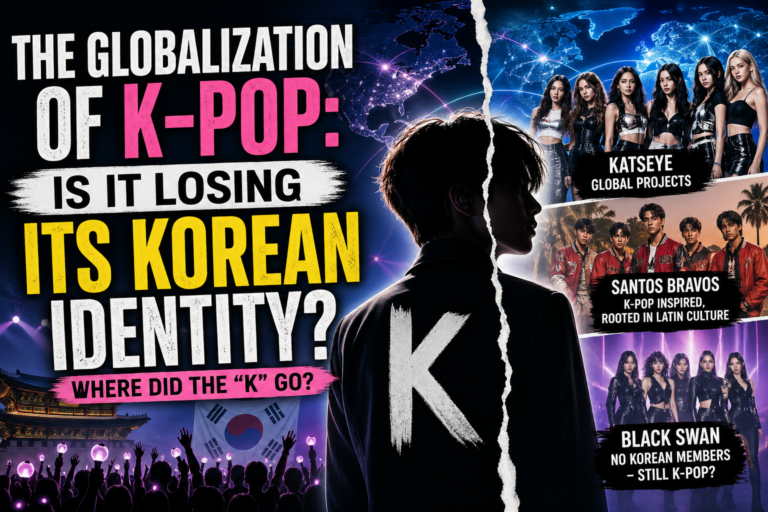
As K-pop expands worldwide, questions grow over whether its Korean identity is fading amid globalized groups and strategies. (Image / kpopbreraking.com)
As K-pop continues its rapid global expansion, a growing debate is emerging within the industry and among fans: is the genre beginning to lose the very identity that once defined it?
What started as a uniquely Korean cultural export—blending language, aesthetics, and tightly structured idol training—has evolved into a global entertainment system. Today’s K-pop is no longer confined to Korea, either in production or in identity. Instead, it is increasingly shaped by international markets, multinational members, and globally tailored strategies.
At the center of this shift are projects like KATSEYE, a group formed under a system designed from the outset for global consumption. Featuring members from multiple countries, their music and visual direction lean heavily toward Western pop sensibilities. While this approach broadens accessibility, it also raises questions about how much of the original “K” remains embedded in the final product.


Global strategy reshapes the K-pop formula
The globalization of K-pop is not accidental—it is strategic. Major entertainment companies have actively pursued overseas markets, building acts that can resonate across regions rather than relying solely on Korean-language content. This includes incorporating English lyrics, adapting musical styles, and diversifying group lineups.
The influence of the K-pop system itself has also spread beyond Korea. Emerging acts such as Santos Bravos demonstrate how the industry’s model—trainee systems, synchronized choreography, and fandom-driven marketing—has been adopted and reinterpreted globally. While these groups reflect K-pop’s structural DNA, their cultural identity is rooted elsewhere, further blurring genre boundaries.
This shift suggests that K-pop may now function less as a geographically defined genre and more as a production framework. However, that transformation comes with trade-offs, particularly when it comes to preserving cultural distinctiveness.

Identity debate intensifies with multinational groups
The conversation becomes more complex with groups like Black Swan, which at one stage promoted without Korean members. Their existence challenges traditional definitions of K-pop, prompting industry observers to reconsider whether nationality, language, or production origin should define the genre.
At the same time, multinational lineups have proven to be a powerful tool for global engagement. Artists such as Lisa and Hanni have built strong regional fanbases, effectively bridging cultures and expanding K-pop’s reach. From a business perspective, this diversification strengthens the industry’s global footprint.
Yet critics argue that as localization increases, the risk of homogenization grows. When K-pop songs adopt global pop trends with fewer Korean linguistic or cultural elements, the genre’s uniqueness may begin to fade. The concern is not about diversity itself, but about whether a single globalized aesthetic could replace the distinct identity that once differentiated K-pop from other music industries.
Industry at a crossroads between expansion and identity
Despite these concerns, the globalization of K-pop has delivered undeniable benefits. It has opened new revenue streams, fostered cross-cultural collaboration, and elevated K-pop to a central position in the global music landscape. The industry’s ability to adapt has long been one of its defining strengths.
However, the current moment represents a critical turning point. As companies continue to prioritize international scalability, they must also consider how to maintain the cultural elements that underpin K-pop’s global appeal. The balance between accessibility and authenticity is becoming increasingly delicate.
Ultimately, K-pop may not be losing its identity as much as redefining it. The genre is evolving from a national export into a global cultural system—one that reflects both its Korean origins and its international ambitions. Whether that evolution strengthens or dilutes its core identity will depend on the choices made by agencies, artists, and audiences alike.
For now, one thing remains clear: K-pop’s global journey is far from over, but the question of what defines it has never been more relevant.

Allen Shin is an editor at Kpopbreaking.com, specializing in K-pop industry news, artist activities, and breaking developments.
📧 Contact: worldpopkorea@gmail.com



Comments