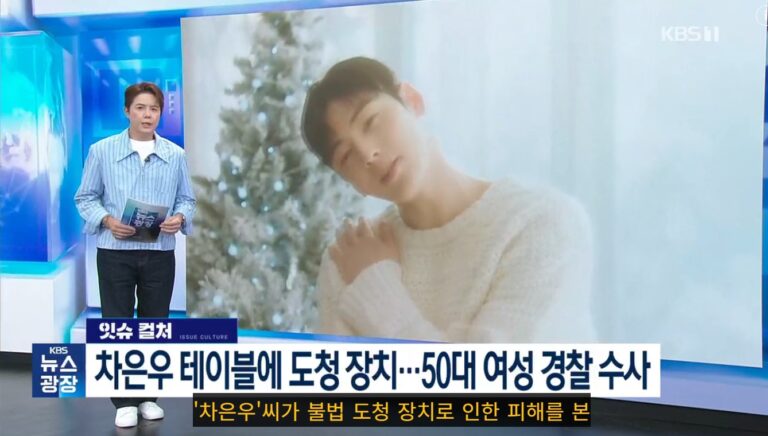
KBS reports on a police investigation into allegations that a listening device was placed beneath a café table to intercept conversations involving Cha Eun-woo. (Photo / KBS News Capture)
A woman in her 50s is under police investigation after allegedly placing listening devices beneath a café table to intercept private conversations involving singer and actor Cha Eun-woo.
South Korean police are investigating a woman accused of secretly listening to conversations involving ASTRO member and actor Cha Eun-woo after allegedly installing listening devices at a café in Seoul.
The Yongsan Police Station in Seoul booked the woman, who is in her 50s, on suspicion of violating South Korea’s Protection of Communications Secrets Act, according to Korean media reports citing police.
The case is still under investigation, and the allegations have not been established by a court.
Listening Devices Allegedly Placed Under Cafe Table
Authorities suspect the woman of placing listening devices beneath a table at a café in Seoul’s Yongsan District on two occasions in August.
Reports state that she allegedly intended the devices to intercept conversations between Cha and an acquaintance.
Police intervened after discovering her as she attempted to retrieve a device on August 30.
Some Korean reports said she had described herself as a fan of Cha Eun-woo. KPOPBREAKING is not characterizing her as a fan or “sasaeng,” however, because that description does not establish her relationship with the artist or her motive.
Authorities are investigating the circumstances surrounding the alleged incidents.
Police Examining Possible Accomplices and Device Source
Police are conducting a digital forensic examination of the woman’s phone as part of the investigation.
Investigators are reportedly examining whether anyone else participated and how the listening equipment was obtained.
Korean reports state that authorities may seek an arrest warrant after conducting further investigation.
Reports indicate that police initially took the woman into emergency custody after discovering her attempt to retrieve a device on August 30. They later released her and continue to investigate without detention.
Observers should not interpret her release as proof that the allegations lack foundation. The criminal investigation remains ongoing.
Why This Case Goes Beyond an Ordinary Celebrity Privacy Dispute
International discussions often frame celebrity privacy violations in Korea through the language of stalking, intrusive photography, or so-called “sasaeng” behavior.
The Cha Eun-woo case centers on alleged interception of a private conversation with an electronic listening device. South Korea’s Protection of Communications Secrets Act governs wiretapping, distinguishing these legal issues from unwanted photography or aggressive fan behavior.
That distinction is important for international readers.
This is not simply an allegation that someone followed a celebrity into a public place. Police are investigating whether equipment was deliberately installed to secretly listen to conversations.

Original Context: Celebrity Privacy Risks Are Becoming More Technological
K-pop’s long-running debate over artist privacy has largely focused on physical access — following artists, obtaining private schedules, appearing at airports or residences, or photographing them without consent.
The allegations involving Cha Eun-woo illustrate another dimension of the problem.
Investigators reveal that privacy risks extend beyond physical intrusion into technological surveillance when they prove someone deliberately placed electronic listening equipment where a celebrity was expected to hold a private conversation.
That dynamic also explains why journalists should not make the suspect’s identity or self-description the main story before investigators complete their work.
Whether the woman calls herself a fan does not determine whether a crime occurred; the evidence gathered by investigators and, if charges proceed, the legal process decide that outcome.
For the K-pop industry, the broader challenge increasingly involves not only protecting artists from people who physically approach them but also safeguarding their private communications in ordinary public and semi-public spaces.
Police have not publicly announced the conclusion of the investigation.
As of publication, there were no official statement from Cha Eun-woo or his agency addressing the specific allegations.
Sources: Yonhap News Agency; Newsis; SBS News; Korean media reports citing Seoul Yongsan Police Station.

Park Minji is a K‑pop writer and journalist who delivers sharp insights and engaging stories on Korean music and culture for global readers.
📧 Contact: trustdouble@naver.com



Comments