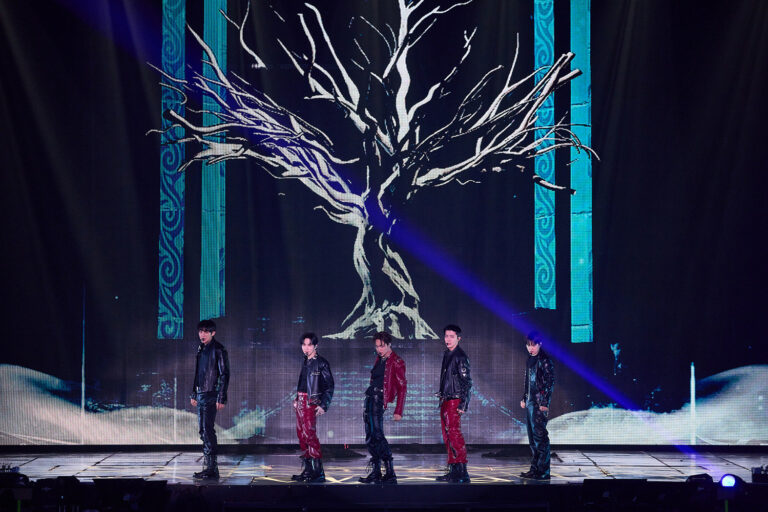
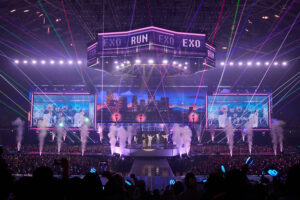
EXO returned to the stage at KSPO Dome for EXO PLANET #6 – EXO’rDIUM in Seoul, their first group concert in over six years and debut as a five-member lineup, drawing 32,000 fans across three days. (Photo / SM Entertainment)
EXO has returned to the stage with a large-scale solo concert in Seoul, marking its first group performance in more than six years and its first official show as a five-member lineup.
The group held its sixth solo concert, “EXO PLANET #6 – EXO’rDIUM in Seoul,” from April 10 to 12 at KSPO Dome in Olympic Park, drawing a total audience of approximately 32,000 fans over three days. The event carried added weight as it followed a 6-year and 4-month hiatus and came after a period of internal changes that saw the group reorganize into a five-member format.
Despite pre-show concerns about how the group would adapt to the reduced lineup and long absence, EXO delivered a tightly structured performance that emphasized cohesion and stage control. The members filled gaps in choreography and redistributed vocal parts seamlessly, presenting a unified front that reflected their experience as veteran performers.
A setlist built on legacy and evolution
The concert opened with “MAMA,” a track closely tied to the group’s debut identity, setting the tone for what would become a retrospective journey through EXO’s discography. The performance quickly transitioned into a series of major hits, including “Monster,” “Growl,” “Overdose,” and “Love Shot,” arranged to maintain momentum while reinforcing the group’s musical continuity.
Rather than functioning as a simple greatest-hits compilation, the setlist was structured to connect past and present. Tracks such as “Tempo,” “Ko Ko Bop,” and “Call Me Baby” were presented alongside EDM-focused segments like “Power” and “Don’t Fight the Feeling,” compressing over a decade of releases into a single, cohesive narrative.
Stage production further expanded this narrative. Large-scale visual elements referencing EXO’s long-running universe—including motifs like the “Tree of Life,” eclipses, and elemental powers—were integrated into the performance. Songs such as “El Dorado” and “Butterfly Girl” were supported by elaborate staging, including gold-toned set pieces, laser mapping, and moving platforms.
Individual stages and group synergy
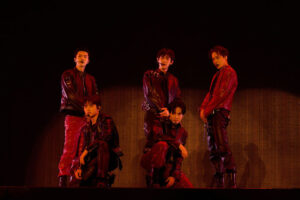
Each member also delivered solo or unit performances, highlighting individual strengths while maintaining the concert’s overall structure. Suho led vocal-heavy stages, while Chanyeol showcased rap-driven segments with dynamic choreography. Kai and Sehun contributed performance-focused stages that emphasized visual storytelling and movement.
These individual segments were positioned not as standalone showcases but as extensions of the group’s identity. Combined, they reinforced EXO’s ability to balance individuality and unity, a factor that has long defined the group’s performance style.
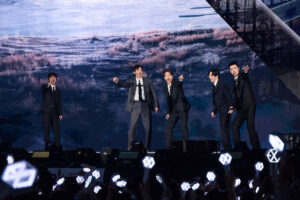
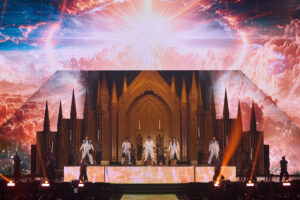
The closing sequence centered on “Forever,” which incorporated symbolic staging elements such as a crown motif to represent continuity between the group and its fandom, EXO-L. The final performances, including “Back It Up” and “Crazy,” featured large-scale choreography with dozens of dancers, leading into an ending stage that visually depicted ascent and renewal.
Return framed as a new chapter
Member comments during the concert reflected both relief and anticipation. The group acknowledged initial concerns about returning after a long hiatus but pointed to the audience’s response as a source of reassurance. They also emphasized their ongoing commitment to performing together, framing the concert as the beginning of a new phase rather than a one-time reunion.
The Seoul shows mark the starting point of EXO’s upcoming global tour, which will span 14 regions. The tour is set to continue in Ho Chi Minh City in April, followed by stops across Asia, including Nagoya, Taipei, Bangkok, Macau, Osaka, Jakarta, Hong Kong, Kuala Lumpur, Manila, Tokyo, Kaohsiung, and Singapore through July.
The scale and execution of the Seoul concerts suggest that EXO’s return is not limited to nostalgia-driven demand. Instead, the group demonstrated that it can still operate as a major touring act, even amid structural changes and an extended absence from the stage.
In that sense, the performance functioned less as a comeback event and more as a reaffirmation of position—one that places EXO back into active circulation within the global K-pop touring landscape.

Park Minji is a K‑pop writer and journalist who delivers sharp insights and engaging stories on Korean music and culture for global readers.
📧 Contact: trustdouble@naver.com


Comments